Fries vs Chips: The Ultimate Potato Showdown

Whether you call them chips or fries, everyone agrees on one thing: nothing beats a pile of golden, crispy potatoes. But how did one humble dish end up with two very different names, styles, and national identities? From the terraced fields of the Andes to the cobblestone streets of Paris, the seaside shops of Britain, and the diners of America, the story of fried potatoes is one of discovery, cultural pride, and pure comfort food perfection.
From the Andes to the Old World
Long before anyone argued over whether they were called chips or fries, potatoes were sacred. The crop originated in the Andes Mountains of South America, where the Inca and other Indigenous peoples cultivated hundreds of potato varieties more than 7,000 years ago.
To the people of the Andes, potatoes were more than food; they were survival. Farmers developed ingenious preservation methods like chuño, a freeze-dried form of potato that could last for years. Potatoes thrived in the high-altitude climate where other crops struggled, becoming the backbone of Andean agriculture and culture.

The Andean people mastered the art of farming in some of the world’s most challenging terrain. Using terraced mountainsides, they transformed steep, rocky slopes into fertile fields that could hold moisture and prevent erosion. These terraces created microclimates, allowing farmers to grow different potato varieties at different altitudes, from the high, frosty peaks to the warmer valleys below. This ingenious system not only supported their communities for thousands of years but also helped preserve a stunning diversity of potatoes that still thrive in the Andes today.

When Spanish conquistadors arrived in the 1500s, led by Francisco Pizarro, who overthrew the Inca Empire in 1533, the contact was catastrophic for Indigenous Andean societies. Warfare, enslavement, and diseases like smallpox decimated entire populations. Yet even amid that devastation, the potato endured. Spanish colonizers brought the crop back to Europe, unaware that this humble Andean root would eventually become one of the world’s most important foods.
And once Europeans had potatoes, it didn’t take long for someone to decide to fry them.
The Humble Beginning of Fried Potatoes
By the 1600s and 1700s, both Belgium and France were cutting potatoes into strips and cooking them in hot fat. The Belgians claim they invented fried potatoes when villagers, unable to catch fish during frozen winters, fried potato strips instead. The French tell a different story: that pommes frites were born in Paris, sold by street vendors along the Pont Neuf bridge in the 1780s.

Whoever did it first, they were on to something. By the time of the French Revolution, fried potatoes had become a beloved street food across Europe: cheap, satisfying, and impossible not to love.
Britain’s Take: Enter the “Chip”
Fried potatoes made their way to Britain in the mid-1800s, where they were called “chips,” short for chipped potatoes. The name came from the act of chipping: cutting the potatoes into thick pieces before frying.
British chips were hearty and comforting: thick-cut, golden, and soft inside. They were easy to make, filling, and affordable, quickly becoming a working-class favorite sold at street stalls and early “chippies.” Chips weren’t meant to be perfectly crisp; they were about warmth, simplicity, and satisfaction, the ultimate comfort food.

Across the Atlantic: The Rise of the “French Fry”
In the United States, fried potatoes took on a slightly different life. Thomas Jefferson famously served “potatoes fried in the French manner” at the White House in the early 1800s, drawing on culinary traditions he encountered while serving as minister to France.
French-inspired cooking didn't end at the White House. Mary Randolph, whose brother married Thomas Jefferson's daughter, published The Virginia House-Wife in 1824, one of America's first bestselling cookbooks. It included recipes for French-style fried potatoes, helping preserve and spread the technique from elite dining tables to home kitchens across the young nation.

By the late 1800s, American restaurants were serving “French fried potatoes,” and during World War I, U.S. soldiers in French-speaking Belgium adopted the phrase “French fries.” When they returned home, the name stuck, and so did the thinner, crispier style of fry that Americans came to love.
As diners, drive-ins, and fast-food chains spread throughout the 20th century, fries became a cultural icon: golden, salty, and perfectly uniform. The American fry was designed for speed, consistency, and crunch.
A Tale of Two Cuts
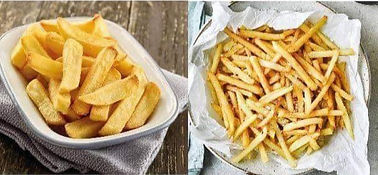
This is where language and texture split for good. In Britain, chips stayed thick, soft, and filling. In the U.S., fries became thin, crisp, and portable.

Other English-speaking countries followed suit with their own mixes. In Australia, New Zealand, and Ireland, “chips” usually refers to the British-style, while “fries” refers to the thinner fast-food version. In Canada, “fries” found fame through poutine, the comforting Quebec dish topped with cheese curds and gravy. Meanwhile, Belgium and France kept their original frites; double-fried for the perfect balance of crisp and fluffy.
More Than Just a Name
Today, the difference between chips and fries is about more than shape or size; it’s about culture. In Britain, chips carry the flavor of tradition: family dinners, seaside takeout, and paper-wrapped comfort. In America, fries represent speed, indulgence, and the joy of eating on the go.
Even though the two terms describe the same basic food, they’ve come to embody two different food philosophies; one rooted in hearty tradition, the other in crisp perfection. And in both cases, the humble fried potato has earned its place as the ultimate comfort food, wherever you’re eating it.
Fun Facts to Snack On
“Steak fries” in the U.S. are basically British-style chips: thick, fluffy, and perfect with vinegar or aioli.
The Belgian city of Bruges has an entire Frietmuseum (yes, a museum dedicated to fries).
Thomas Jefferson’s cooks wrote one of the earliest American recipes for fries: calling for potatoes cut “small and deep-fried in lard.”
In the U.K., “crisps” are what Americans call potato chips: thin slices fried until crunchy.
The average American eats about 30 pounds of fries per year, while the average Brit eats about 100 portions of chips annually.
Double-frying, a Belgian trick, is what gives fries that perfect golden crisp outside and soft, steamy inside.
After 9/11, a few U.S. restaurants (and even the Congressional cafeteria) briefly renamed French fries to “Freedom Fries” as a political statement when France opposed the Iraq War — a short-lived but memorable moment in fry history.
So… Who Wins the Showdown?
Whether you’re Team Chips or Team Fries, it’s hard to pick a loser when both sides are this delicious. Thick or thin, soft or crunchy, wrapped in paper or served in a basket, fried potatoes are proof that comfort food speaks a universal language.
Tell us: are you Team Chips or Team Fries?


Comments